

The Government of Nepal has introduced significant changes to the income tax structure for Fiscal Year 2083/84 (2026/27). The new rates apply from 1 Shrawan 2083.
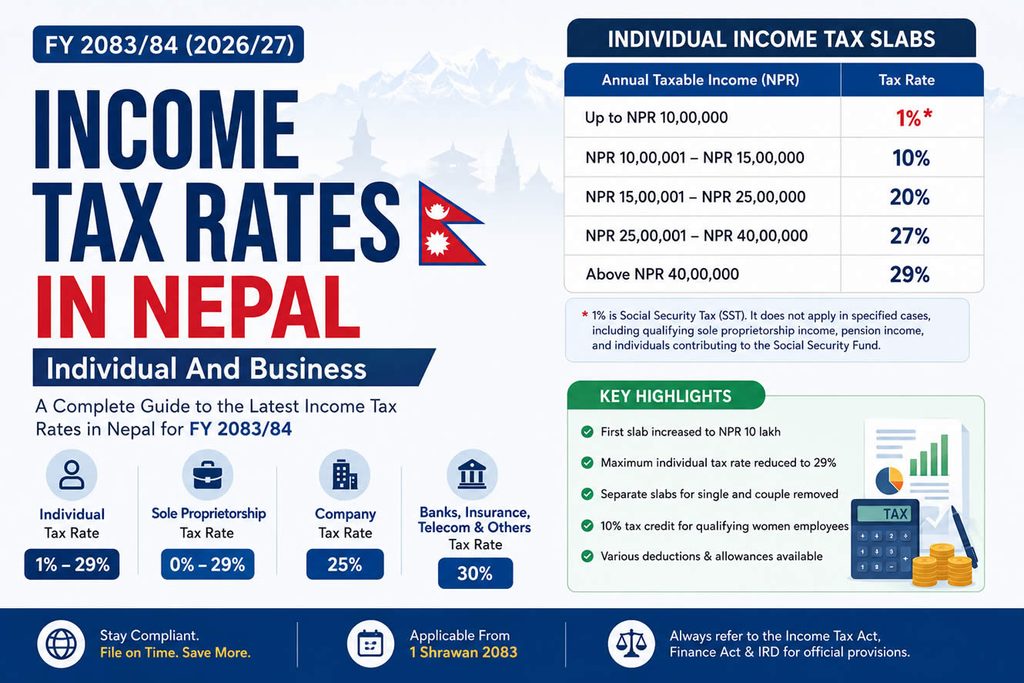
One of the biggest changes is the expansion of the first individual income-tax slab from Rs. 5 lakh to Rs. 10 lakh and the reduction of the maximum marginal rate from 39% to 29%. The separate tax slabs previously applicable to single individuals and married couples have also been unified.
This article explains the Nepal income tax rates for 2083/84, including individual income, salary income, sole proprietorship businesses, private limited companies, and major sector-specific corporate tax rates.
Nepal Income Tax Slabs for FY 2083/84
For resident natural persons, the new tax structure has five major income-tax bands.
| Annual Taxable Income | Tax Rate |
|---|---|
| Up to Rs. 10,00,000 | 1%* |
| Rs. 10,00,001 – Rs. 15,00,000 | 10% |
| Rs. 15,00,001 – Rs. 25,00,000 | 20% |
| Rs. 25,00,001 – Rs. 40,00,000 | 27% |
| Above Rs. 40,00,000 | 29% |
*The first 1% is technically Social Security Tax (SST) and does not apply in specified cases, including qualifying sole proprietorship income, pension income, and individuals contributing to the Social Security Fund.
Important Point
The tax system is progressive. This means that when your taxable income enters a higher slab, the higher rate applies only to the income falling within that particular slab—not to your entire income.
For example, a person with Rs. 20 lakh of taxable income does not pay 20% on the entire Rs. 20 lakh.
Individual Income Tax Calculation Example
Suppose an individual has Rs. 20,00,000 taxable income in FY 2083/84.
The calculation would be:
| Income Portion | Rate | Tax |
|---|---|---|
| First Rs. 10,00,000 | 1% | Rs. 10,000 |
| Next Rs. 5,00,000 | 10% | Rs. 50,000 |
| Next Rs. 5,00,000 | 20% | Rs. 1,00,000 |
| Total | Rs. 1,60,000 |
Therefore, the tax is Rs. 1,60,000, before considering applicable deductions, rebates, or exemptions.
What Has Changed in FY 2083/84?
The new tax structure represents a substantial change compared with FY 2082/83.
| Particular | FY 2082/83 | FY 2083/84 |
|---|---|---|
| First slab | Rs. 5 lakh / Rs. 6 lakh | Rs. 10 lakh |
| First rate | 1% | 1% |
| Second rate | 10% | 10% |
| Third rate | 20% | 20% |
| Fourth rate | 30% | 27% |
| Maximum marginal rate | 39% | 29% |
| Separate single/couple slabs | Yes | No |
The Finance Bill 2083 unified the individual and couple schedules and reduced the upper individual tax rate.
Is Rs. 10 Lakh Income Tax-Free in Nepal?
No.
This is an important point that is often misunderstood.
The first Rs. 10 lakh of taxable income is subject to a 1% Social Security Tax, rather than being completely tax-free. However, the 1% tax does not apply to certain taxpayers, such as qualifying sole proprietors, pension income recipients, and individuals contributing to the Social Security Fund.
Therefore, simply saying “income up to Rs. 10 lakh is tax-free” is not technically correct.
Income Tax Rate for Sole Proprietorship Business in Nepal
A sole proprietorship is generally treated as the business income of a resident natural person.
For FY 2083/84, the same unified progressive tax structure applies to taxable business income, but the 1% Social Security Tax in the first slab does not apply to qualifying sole proprietorship business income.
Therefore, broadly:
| Taxable Business Income | Applicable Rate |
|---|---|
| Up to Rs. 10,00,000 | 0% |
| Rs. 10,00,001 – Rs. 15,00,000 | 10% |
| Rs. 15,00,001 – Rs. 25,00,000 | 20% |
| Rs. 25,00,001 – Rs. 40,00,000 | 27% |
| Above Rs. 40,00,000 | 29% |
Example: Sole Proprietorship
Suppose a proprietor has Rs. 20 lakh taxable business income.
- First Rs. 10 lakh = 0%
- Next Rs. 5 lakh = 10% = Rs. 50,000
- Next Rs. 5 lakh = 20% = Rs. 1,00,000
Total income tax = Rs. 1,50,000
This calculation assumes the income qualifies as sole-proprietorship business income and excludes other applicable adjustments.
Corporate Income Tax Rate in Nepal for FY 2083/84
The income tax rate for a company differs from the personal income tax slab.
For a general company, the standard corporate income tax rate remains 25%.
| Type of Business / Entity | General Income Tax Rate |
|---|---|
| General company/business entity | 25% |
| Banks and financial institutions | 30% |
| Insurance companies | 30% |
| Telecommunications and certain internet services | 30% |
| Tobacco, cigarettes and specified tobacco businesses | 30% |
| Alcohol and beer businesses | 30% |
| Petroleum-related businesses | 30% |
| Certain special industries | Special rates/incentives may apply |
| IT/export-oriented businesses | Special incentives may apply |
The actual tax liability can differ depending on the nature of the entity, applicable incentives, deductions, exemptions and sector-specific provisions.
Company Tax vs Sole Proprietorship Tax in Nepal
One of the most important decisions for a business owner is understanding the difference between operating as a sole proprietorship and operating through a private limited company.
Sole Proprietorship
The business profit is generally taxed as the individual’s business income using the progressive individual tax structure.
Private Limited Company
A company is a separate legal entity and generally pays corporate income tax at the applicable corporate rate. A standard company generally falls under the 25% corporate tax rate.
Therefore, business owners should not compare the 29% individual maximum rate directly with the 25% company rate without considering the complete tax implications, including dividend taxation, allowable expenses, compliance costs and other applicable taxes.
Tax Deductions and Rebates for Individuals
Taxable income is not always the same as gross income. Certain deductions and allowances may reduce taxable income if the taxpayer satisfies the relevant legal conditions.
For FY 2083/84, examples include:
| Deduction / Allowance | Maximum / Applicable Limit |
|---|---|
| Life insurance premium | Up to Rs. 40,000 |
| Health insurance premium | Up to Rs. 20,000 |
| Approved retirement fund contribution | Lower of prescribed limits, including Rs. 5,00,000 / one-third of assessable income / actual contribution |
| Private building insurance | Up to Rs. 10,000 |
| Education fee | Subject to prescribed limit |
| Remote area allowance | Depending on area |
| Disabled allowance | Additional deduction under applicable conditions |
These deductions are subject to the requirements and limitations prescribed by Nepal’s tax law.
Female Tax Rebate
The tax framework also provides a 10% tax credit/rebate for qualifying women whose income is from employment only, subject to the conditions prescribed by law.
Taxpayers should verify the applicable conditions before claiming the rebate in their tax return.
Income Tax on Salary in Nepal
For salaried employees, employers generally calculate and deduct tax at source based on the applicable annual income-tax structure.
For FY 2083/84, the basic individual salary-tax slabs are:
- First Rs. 10 lakh: 1%
- Next Rs. 5 lakh: 10%
- Next Rs. 10 lakh: 20%
- Next Rs. 15 lakh: 27%
- Above Rs. 40 lakh: 29%
However, actual salary tax may be lower after considering eligible retirement contributions, insurance deductions, allowances, rebates and other applicable provisions.
Does Married Status Change Income Tax in FY 2083/84?
The separate married-couple slab structure has been removed under the revised FY 2083/84 schedule.
The revised schedule provides a unified structure for resident individuals/couples rather than maintaining the previous separate first-slab thresholds.
This is one of the major changes taxpayers should be aware of when comparing FY 2082/83 with FY 2083/84.
Frequently Asked Questions
1. What is the income tax rate in Nepal for FY 2083/84?
The individual income-tax rates range from 1% to 29%, depending on the taxable income slab. The standard corporate income tax rate for a general company is 25%.
2. What is the tax rate for Rs. 10 lakh income in Nepal?
For a qualifying salary/employment taxpayer, the first Rs. 10 lakh falls under the 1% Social Security Tax, subject to applicable exemptions. For qualifying sole proprietorship business income, the first Rs. 10 lakh is not subject to that 1% SST.
3. What is the maximum individual income tax rate in Nepal?
For FY 2083/84, the maximum marginal individual rate is 29%.
4. What is the company income tax rate in Nepal?
A general company is generally subject to 25% income tax. Certain sectors, including banks, financial institutions, insurance and specified businesses, may be subject to 30% or other special rates.
5. Is the first Rs. 10 lakh completely tax-free?
No. For qualifying employment income, the first Rs. 10 lakh is generally subject to 1% Social Security Tax, although specified taxpayers are exempt from that 1% tax.
6. Does a sole proprietor pay 1% tax on the first Rs. 10 lakh?
No, the 1% Social Security Tax does not apply to qualifying sole-proprietorship business income.
7. When did the new tax rates become effective?
The revised FY 2083/84 tax structure applies from 1 Shrawan 2083, corresponding to the beginning of Nepal’s FY 2083/84.
Conclusion
The Income Tax Rates in Nepal for FY 2083/84 bring significant changes for individual taxpayers. The first 1% slab has increased to Rs. 10 lakh, the 27% slab has replaced the previous 30% band in the relevant range, and the maximum marginal rate has fallen from 39% to 29%.
For businesses, the standard corporate income tax rate remains 25%, while banks, insurance companies, telecommunications and certain other sectors generally continue to face higher rates or special tax provisions.
Because Nepal’s tax system includes deductions, rebates, withholding taxes, advance tax, sector-specific rates and special provisions, taxpayers should calculate their actual taxable income rather than simply applying the highest tax rate to total income.
For official tax compliance, taxpayers should always verify the applicable provisions of the Income Tax Act, Finance Act and Inland Revenue Department (IRD) before filing a return or making a tax payment. The IRD’s published materials explain the applicable tax framework and related provisions.

